Emergent Forms: Emergence, Process, and Artificial Life
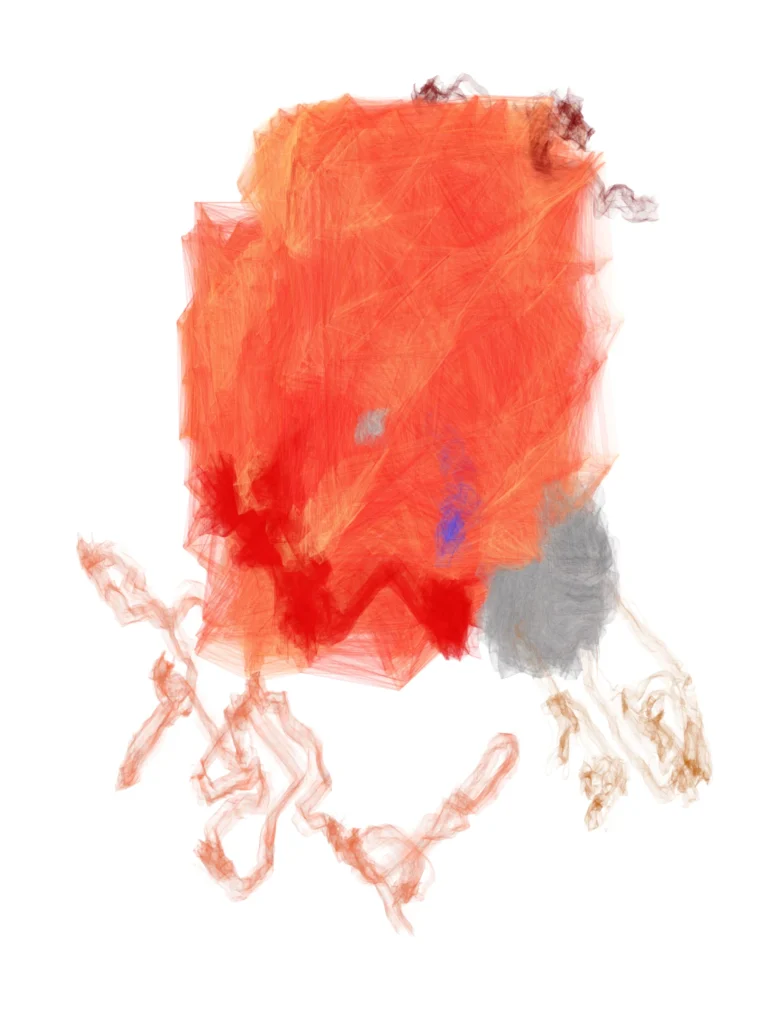
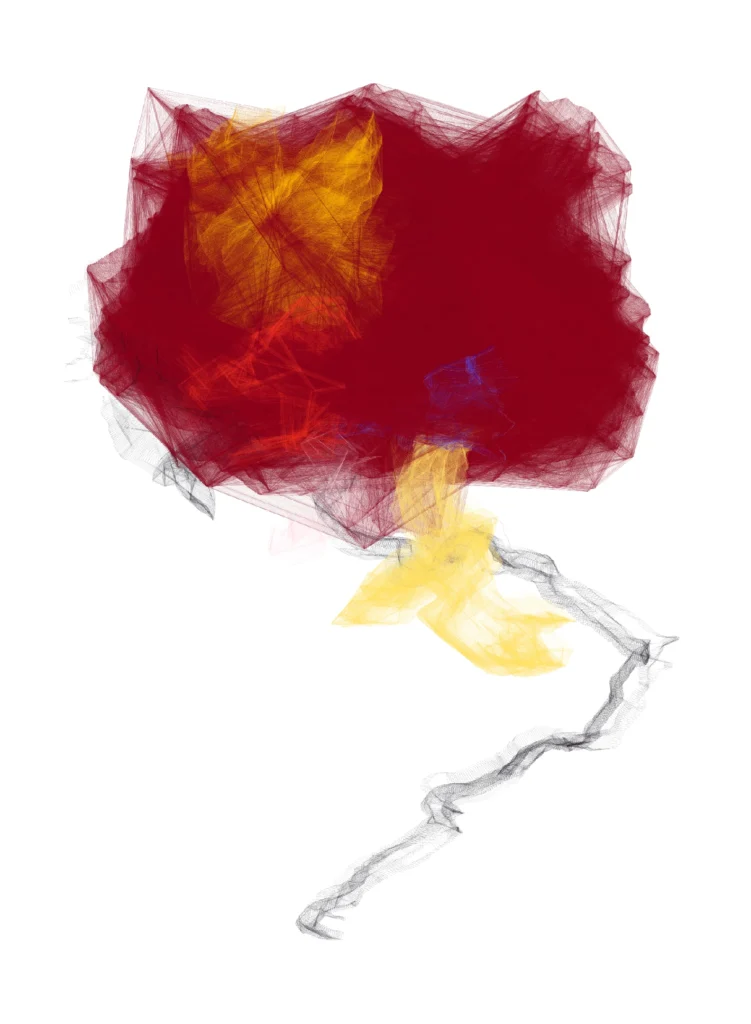
Scientific imaging of micro-organisms provides an important visual and conceptual reference for this body of work. Such images often appear simultaneously structured and unstable, legible yet alien: they display recognizable organization while resisting familiar categories of form. Produced through microscopes, staining techniques, and computational processing, they are shaped by layers of instrumental and interpretive mediation. Occupying a boundary between observation and inference, these images present patterns that suggest life-like organization without resolving into stable, intuitive forms.
Where Signs of Artificial Life establishes the generative capability and the conditions under which emergence becomes perceptible, Forms begins from what that system produces. The focus shifts from developing a system that can behave in life-adjacent ways to working with its outputs as provisional objects—images that already carry a history of interaction, accumulation, and time.
The visual ambiguity characteristic of scientific imaging is closely tied to the concept of emergence. In fields ranging from complexity science and origin-of-life research to artificial life, emergence describes how organized behavior arises from local interactions without centralized control. Form is not designed in advance but appears as the cumulative effect of constraint, interaction, and duration. Emergent systems are therefore structured but not predictable; their outcomes must be discovered rather than specified.
In Forms, this understanding is operationalized through a generative process already developed in earlier work. Custom software produces continuously evolving patterns through the interaction of multiple components within a shared environment. These interactions generate lines that accumulate over time, unfolding as an abstract animation rather than converging on a single predetermined image. Rather than treating this ongoing display as a finished work, the artist engages it as a field of emergence, observing its behavior and identifying moments at which coherent yet unstable structures appear.
From this continuous flow, discrete images are sampled and curated. Selection becomes a critical act: some executions yield multiple moments of interest, others none. These selected images function as transitional objects—records of emergent behavior that are neither raw output nor completed works. They carry forward the internal logic of the generative system while remaining open to further transformation.
The process then shifts into a materially distinct phase. Selected images are digitally printed and further worked by hand using encaustic, graphite, and oil paint. This stage introduces a slower, tactile temporality that responds to what has already emerged rather than directing it. Manual interventions emphasize, obscure, or redirect elements within the image, allowing new relationships to form between computational structure and material gesture. Matting and framing complete the process, stabilizing the image as a discrete object and situating it within physical space.
Viewed as a whole, Forms can be understood as an extension rather than a repetition of the concerns established in Signs. If the earlier series asks how emergence can be generated and made visible, Forms asks how particular emergent moments can be held, shaped, and encountered as objects. The work does not simulate life, nor does it seek to explain it. Instead, it offers a sequence of stabilized encounters with systems that behave in excess of intention, inviting sustained looking and reflection on emergence as an aesthetic and material experience.