Indeterminacies: Generative Images at the Threshold of Appearance
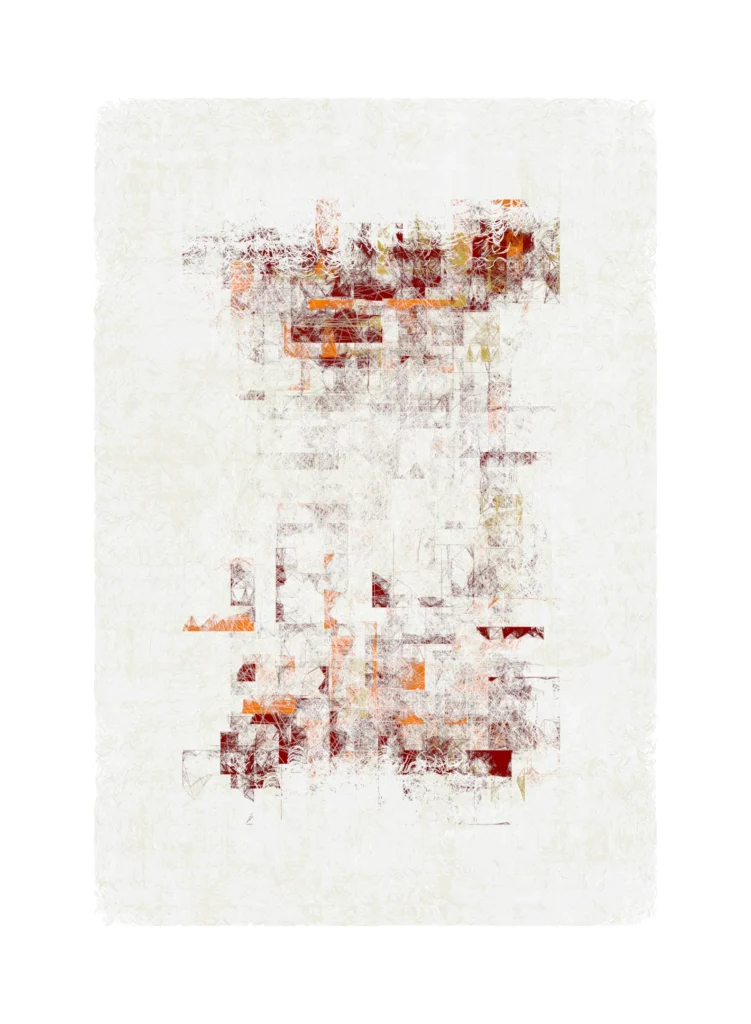
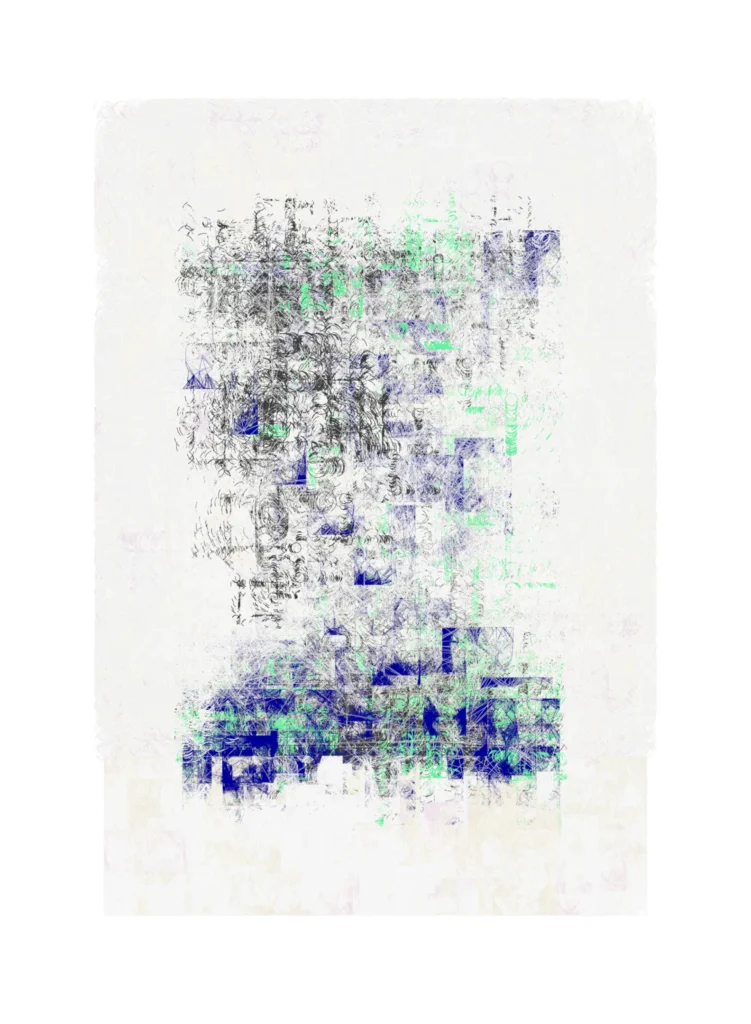
The Indeterminacies series emerges from a sustained investigation into how form appears under conditions of constraint, uncertainty, and partial legibility. Following the earlier Signs of Artificial Life works, which foregrounded generative processes as a way of engaging emergence directly, Indeterminacies shifts emphasis from visible dynamics to perceptual conditions. The images do not present emergent form as an object to be observed, but rather stage a situation in which form becomes only intermittently apprehensible, always on the verge of dissolution back into its ground.
At the core of the series is a generative program that produces accumulations of lines whose individual trajectories are governed by rules and constraints rather than compositional intent. These rules do not encode representational goals or symbolic outcomes. Instead, they regulate density, orientation, and spatial containment, allowing the resulting image to arise as a contingent event rather than a designed configuration. The artist’s role is thus not to determine form but to construct the conditions under which form may appear.
A key formal strategy in Indeterminacies is the modulation of perceptual clarity across the image surface. The use of nested rectangular territories, while structurally prominent at the level of code, is not a visible compositional motif. These territories function infrastructurally, serving to subtly vary contrast, tonal density, and accumulation across the surface. The result is a vignette-like field in which the outer regions recede into a misty, low-contrast ground, while the central zone allows denser formations to emerge. Even here, however, clarity is provisional: the form never fully resolves into a stable figure.
This approach draws inspiration from East Asian ink painting, particularly Hasegawa Tōhaku’s Pine Trees. In Tōhaku’s work, mist is not a background against which trees are placed; rather, mist is the condition that allows trees to appear. Forms emerge gradually, partially, and unevenly, suspended between presence and absence. Indeterminacies adopts a comparable logic, translating it into a generative and abstract idiom. The “mist” in these images is not pictorial atmosphere but a perceptual field generated through accumulation, attenuation, and constraint.
The conceptual stakes of this approach extend beyond formal resemblance. The series aligns with Zen Buddhist notions of emptiness (śūnyatā) and dependent origination, in which phenomena do not possess intrinsic, self-sustaining identity but arise only through relational conditions. In Indeterminacies, no mark, cluster, or region claims priority or autonomy. What appears does so only temporarily, as an effect of intersecting constraints, densities, and thresholds of visibility. Form is not opposed to emptiness; it is emptiness taking provisional shape.
At the same time, the work resonates with contemporary complexity science, particularly perspectives that emphasize emergence without privileging fixed scales or stable representations. The images do not visualize underlying rules or systems; nor do they offer diagrams of generative behavior. Instead, they operate at the level of experience, allowing viewers to encounter emergence as something sensed rather than decoded. The generative process functions less as an explanatory mechanism than as a means of producing epistemic humility: the recognition that what is seen is always partial, contingent, and subject to revision.
This orientation also situates Indeterminacies within a lineage of historical epistemology, where knowledge is understood as provisional, situated, and shaped by material practices of observation. The images resist closure and decisiveness. They do not reward prolonged looking with definitive insight, nor do they collapse into pure noise. Instead, they sustain a tension between legibility and opacity, inviting viewers to remain with uncertainty rather than resolve it.
Importantly, Indeterminacies does not seek to represent indeterminacy as a theme. The images do not illustrate philosophical concepts or scientific theories. Rather, they enact indeterminacy through their visual behavior. What the viewer encounters is not a depiction of uncertainty but an experience of it: a sustained negotiation between emergence and disappearance, form and field, attention and dissolution.
In this sense, Indeterminacies can be understood as a form of phenomenological abstraction. The works do not assert meaning but condition perception. They ask not “What does this image depict?” but “Under what conditions does something become visible at all?” The answer is never final. Each image stages that question anew, allowing form to arise, hesitate, and recede, leaving behind not resolution but attentiveness.